Dronotope
An interactive 3D “untimeline”
Dronotope: Emerging Technologies and the Politics of Timeline Visualisations
Data visualisations are increasingly prevalent in the public understanding of contemporary geopolitical issues, from the spread of COVID-19 to the numbers of forced migration, from the AI arms race to renewed nuclear proliferation. Yet all data visualisation conventions, whether bar graphs, line graphs, or 3D “scrolly-telling” forms, shape how users perceive and understand the topic being presented. Although they can appear objective and neutral—from the way data points are compiled to the way their occurrences, distributions, or correlations are presented—certain views are legitimated and certain narratives appear natural or self-evident. As a specific form of design intended to illustrate or show identifiable trends or issues, data visualisations have consequences on areas including, but not limited to, public perceptions, behaviour, and policy preferences. They are political by virtue of being productive of particular forms of knowledge and power.
However, despite their implicit claims to illumination and insight, there are opacities and lacunae within data visualisations. These matter in particular ways for timeline visualisations, which are post-hoc exercises in temporal reconstruction and order-making. Typically, this genre presents an x-y axis of chronological time and “evental” time, a point at which something notable or meaningful has occurred. For timelines of emerging technologies, the x-y axis suggests continual development or innovation, where a technology’s evolution appears linear and progressive over time, even teleological. While making perhaps otherwise unruly data interpretable, this approach risks obscuring the many ways that a technology could have been otherwise and how it has been or are used for other purposes. In this way, timelines of emerging technologies can present a metanarrative of technological developments, one where a technology’s eventual, as-yet-unrealized future legitimates, justifies, and provides meaning to its present and past. Needless to say, the idea of inevitability is good for business: although designers and purveyors cannot completely control or foresee a technology’s uses, assumptions of inevitability make the case for continued investment and commitment to their products.
Can timeline visualisations of emerging technologies convey more heterogeneous kinds of narratives? Can timelines capture the contradictions and contingencies behind how a technology develops, and how and where it comes to be used? Can these types of visualisations be reflexive and emphasize, even challenge, how knowledge and authority around a technology comes to be constructed and consolidated? If so, what kinds of data would be used, and what kind of form would such a timeline take?
Inspired in part by feminist thought that looks to “unmask universalism” and situate knowledge in specific bodies, institutions, and infrastructures, the team at the Centre for Drones and Culture sought to create an “untimeline” that could undo the conventional form of timeline visualisations. Drawing from the interests and expertise of the research team – covering drone use across different realms, including art and aesthetics, war and security, humanitarianism, and ecology – we considered how to create an object that works against narratives of technological inevitability.
This is an experiment in the vein of a speculative design. As Anthony Dunne and Fiona Raby put it, speculative design is:
a means of speculating how things could be… This form of design thrives on imagination and aims to open up new perspectives on what are sometimes called wicked problems, to create spaces for discussion and debate about alternative ways of being, and to inspire and encourage people’s imaginations to flow freely. Design speculations can act as a catalyst for collectively redefining our relationship to reality.
Speculative approaches form one avenue through which we aimed to critique the knowledge infrastructure of timelines themselves, and to explore alternative, self-conscious versions of telling the recent histories and contingencies of emerging technologies.
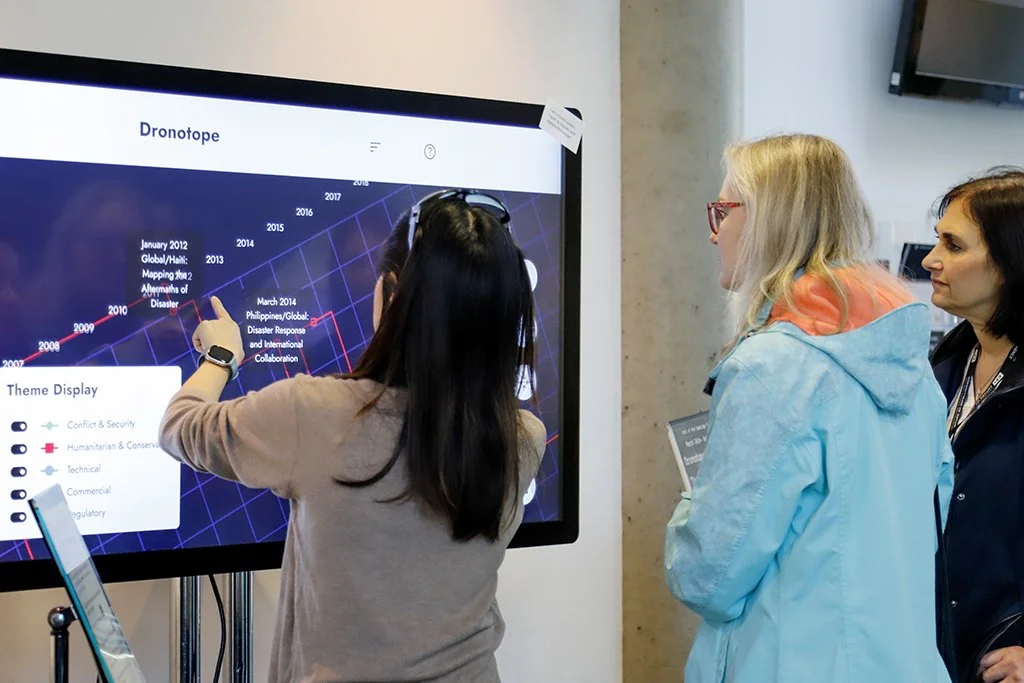
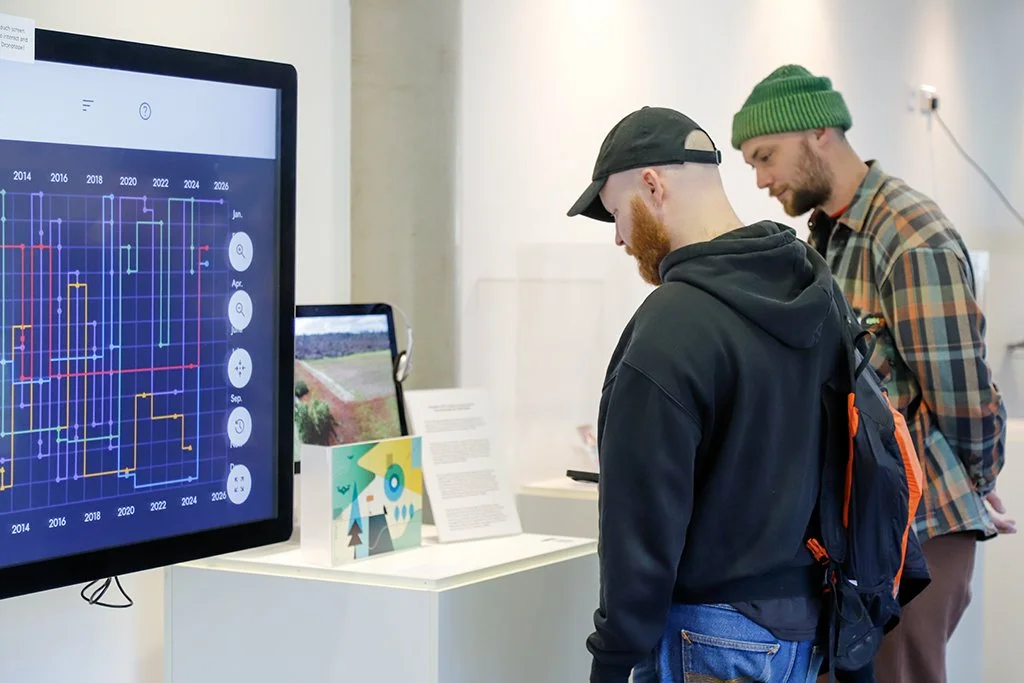
Drones were our chosen case study because of the dizzying proliferation of drones across diverse sectors. The result is Dronotope, a visualisation that charts drone developments from 2000 to 2025 via five strands: 1) the use of drones in war, 2) the use of drones in humanitarianism and conservation, 3) the establishment of drone regulations, 4) technical developments, including in drone design and related areas like AI and sensors; 5) and the use of drones in civil and domestic settings. These five strands diverge and converge at various points of the untimeline, highlighting at times conjunctions across different drone stories. It is also interactive and reflexively curated: the user has the choice to feature or take away one or more strands, or, through a keyword function, to identify what individual data points are tagged in more than one category.
The untimeline is presented in a grid format that nevertheless has a three-dimensional and volumetric parallax effect: the user is able to zoom “into” the time-space of Dronotope, and as they do so, data points emerge into visibility, along with their accompanying text come into visibility. As the user navigates the untimeline, the data points appear to shift position, coalescing and dispersing, depending on the moment by moment transformations in perspective. An exercise in the politics of attention – for data is often what one trains one’s focus on, influenced by different goals and motivations – Dronotope’s interactivity is key to encouraging pluralistic ways of thinking about our drone age. It is intended to reflect the fact that emerging technologies do not develop out of siloed sectors; user perceptions and attitudes to technology can and do shape how the technology is used, and where and whom it reaches.
We created three initial prototypes that had different shapes and forms, and that used different algorithms. We workshopped these timelines and sought feedback through online focus groups with participants from different backgrounds, some who researched drones, some who researched design, and some who had no especial interest in either. The version presented here is the fourth design—though this is by no means the “final” version in the sense of it being the best or ultimate outcome that the others inevitably led to. We embraced this version as the one that seemed to best enable what Dronotope aimed to achieve, but each prototype created an untimeline in their own way and carried different meanings and possibilities, all noisy and messy and full of friction in ways conventional timelines may not be.
The name Dronotope is a nod to Mikhail Bakhtin’s (1937) concept of “chronotope”, his term for describing the interconnections between temporal and spatial relations as they are organized in narrative, and how these influence the meaning of cultural works like literary texts. Time and space are organized in a particular way within Dronotope, and they structure its conception and creation too. We are biased here: each member of the research team assembled a set of individual data points, and they reflect our individual knowledges and research interests. The visualisation does not claim to produce “views from nowhere, everywhere, and somewhere” in the abstract, but one that comes from us, a core group of five academics from across the humanities, social sciences, and computer sciences, who used our own partial knowledges of the drone world to think about how to turn visualisations reflexively back onto themselves and to undo some of the epistemic claims they purport to make.
While creating Dronotope, we found that a brief survey of existing drone timelines tended to focus on two kinds of developments: military drone innovations, and commercial drone integration. While both chart events that are consequential to understanding the future of drones, they reinforce “big” uses of drones in the form of militarism and capitalism. Where does epistemic possibility and power lie, if drone futures are articulated by the same groups who own, manufacture, and sell the technologies that are themselves imagined as driving those very futures? This question, and the way it identifies a narrowing of horizons, is all the more pertinent in the world of drones: there, commercial groups frequently tout unmanned technology’s widespread “inevitability” and their desire to help others not be “left behind”.
To be sure, there are drawbacks to speculative design: from critiques of its lack of practicality and utility, to the way designs can be misinterpreted as predictions or recommendations. Drawing critical attention to the underlying work that visualisations do—to the attitudes they may convey and impressions they may cultivate—Dronotope hopes to be a provocative means of “doing research,” of generating questions that might otherwise go unasked, and of querying assumptions about technology and time that might otherwise go unnoticed.
Credits for Dronotope:
From the Centre for Drones and Culture: Beryl Pong (project lead), Richard Carter (timeline designer), Amy Gaeta, Marjory da Costa-Abreu, Joanna Tidy
Dronotope: The Politics of Timelines and Data Visualisations
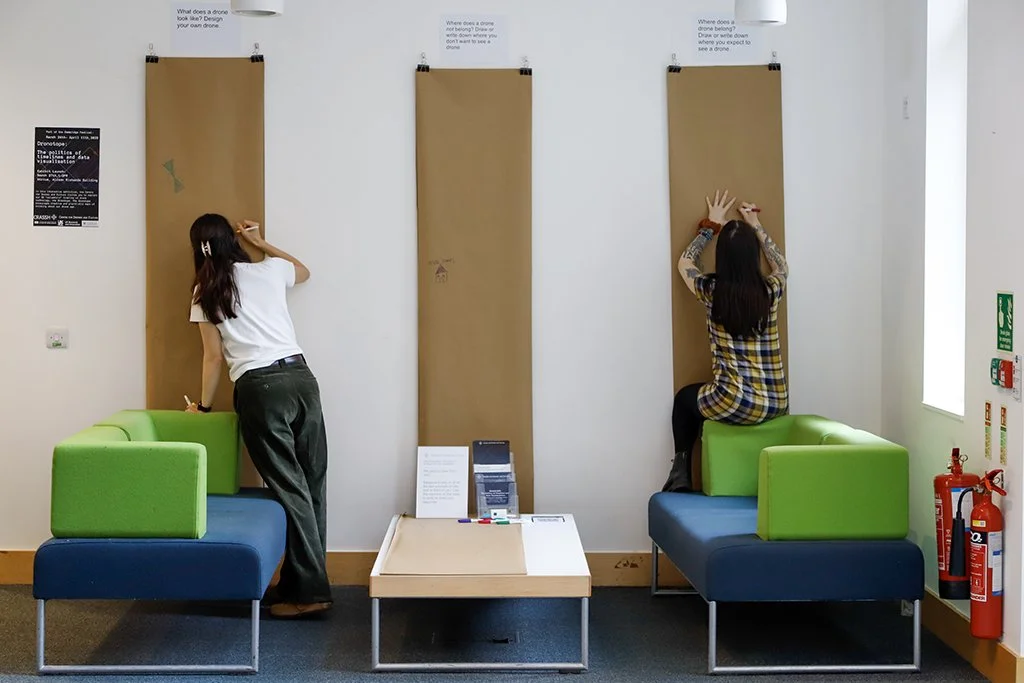
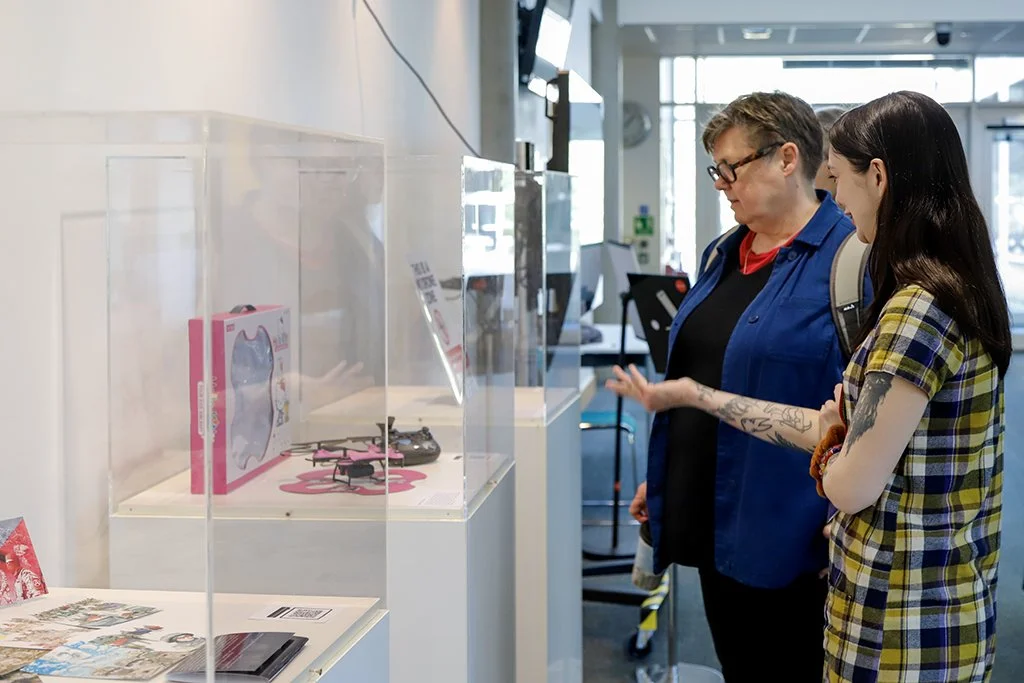
First shown 24 March - 11 April 2025 as part of the Cambridge Festival at the Centre for Arts, Social Sciences, and Humanities (CRASSH)
Alison Richards Building, University of Cambridge, 7 West Road, Cambridge CB3 9DP
Photography by Judith Weik