
Reflection: Understanding drone warfare through virtual reality
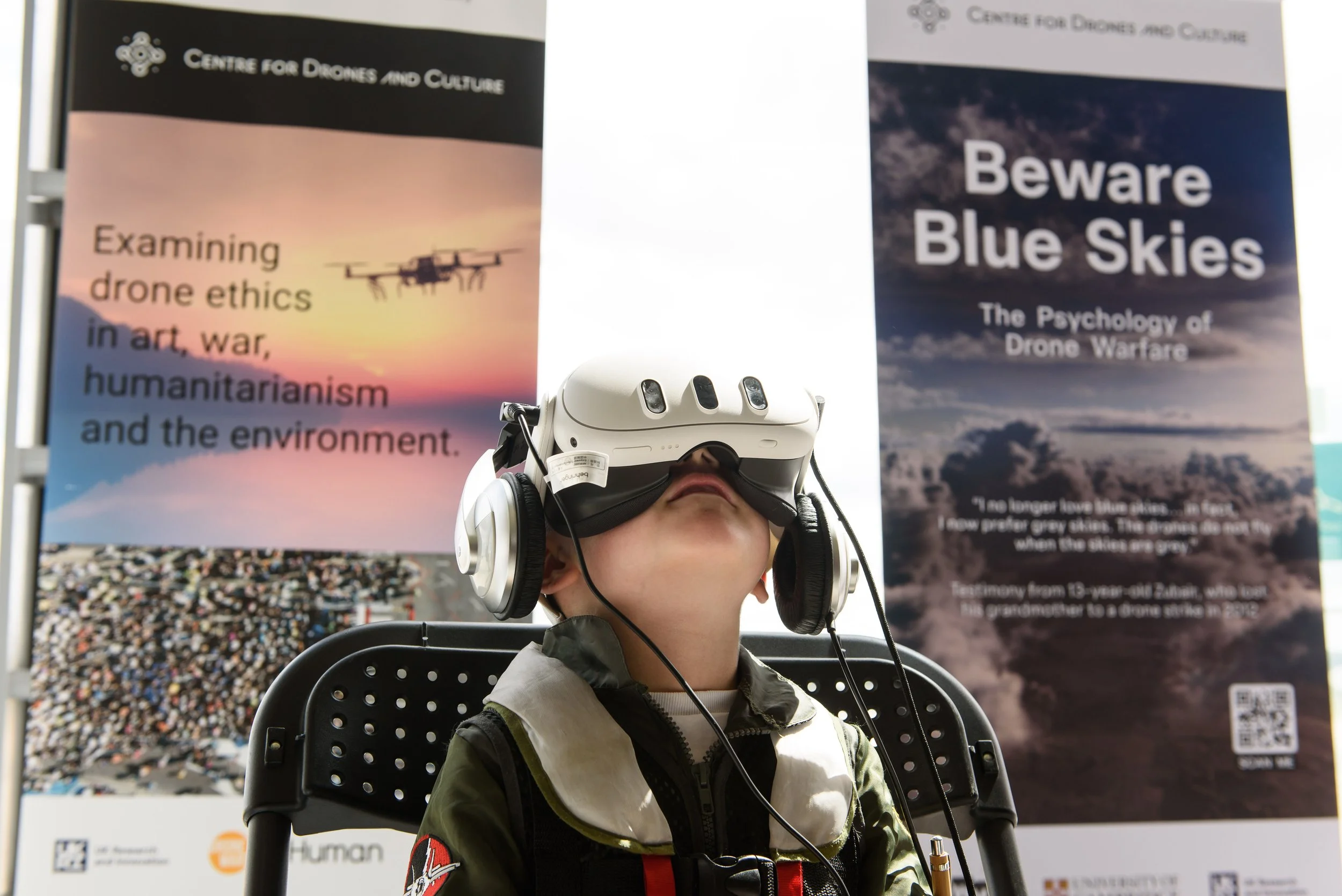
Beware Blue Skies at the Imperial War Museums, Duxford. All photography by Richard Eaton.
By Rory Siah, CDAC Research Assistant
In August 2025, I joined the Cambridge University Leverhulme CFI project Beware Blue Skies: Exploring the Psychology of Drone Warfare, an immersive virtual reality (VR) installation exhibited at the Imperial War Museum (IWM) Duxford, which was led by Dr. Beryl Pong. The film, produced in collaboration with the IWM and the Centre for Drones and Culture, invites viewers to inhabit the psychological distance between those who operate drones and those who live under them. As a research assistant, my work centred on observing and understanding how the public engaged with this experience. I conducted field research over multiple exhibition days, compiling and analysing visitor responses to the film. My role required balancing the practical and the interpretive: assisting the VR technical personnel to ensure accessibility and smooth delivery, while also eliciting from visitors their emotional and ethical reflections—moments of confusion, empathy or discomfort that revealed how people encounter war through technology.
I: The Big Blue - Floaters or Pixels?
The exhibition was held in the American Air Museum of the IWM—a place whose very architecture seemed to breathe aviation history, its vast steel ribs sheltering the quiet relics of flight. Our booth, incongruously contemporary amongst the suspended wings of polished fuselages, was positioned behind a great pane of glass that opened directly onto the airfield. From where I stood, the horizon unrolled in painterly linearity: tarmac, grass, then sky—an almost allegorical composition of earth and air.
It was, at first glance, a curious setting for a virtual-reality work. The proverbial museum is a house of completed narratives, a mausoleum of machines that have fulfilled their destinies and now rest in curated stillness. VR, by contrast, still enjoys a public reputation as something vaguely futuristic, a medium associated with frontiers rather than archives. And yet here they were—past and future—nested within one another in a quiet visual paradox. Visitors queued to enter a headset that promised immersion while standing beneath aircraft embalmed in memory; the relics surrounded the prototype, and in doing so transformed it into a relic-in-waiting. This was the chiasmus that governed the space: the past contained the future, even as the future reanimated the past. Once people stepped out of the VR experience, their eyes often drifted upward toward the hanging Spitfires with an altered gaze, as though the wings above them flickered between aluminium and pixel, between artefact and apparition. Likewise, the hangar shaped the way the virtual world was received; surrounded by the polished skeletons of flight, viewers seemed primed to treat the simulated sky with a solemn sincerity it might not have possessed in any other setting.
Operating in that position meant working beneath the unflinching glare of the sun. After several hours of standing in that warm luminescence, I began to understand, in a minute and admittedly comic way, young Zubair’s lament that he had “no longer loved blue skies” (Zubair was a 12-year-old boy who lost his grandmother to a drone strike near North Waziristan in 2012). I too, by the end of the day, found myself secretly praying for the mercy of a cloud or two. (Of course, my grievance was only meteorological; the heat could hardly compare to the terror of those who have witnessed real drones above Waziristan’s skies.)
What fascinated me more, however, was the curious doubleness of our placement. Just beyond the window lay the vast blue expanse of the actual heavens, occasionally animated by the slow, majestic ascent of a Spitfire. Yet within the headsets, visitors were shown another sky—an imitation, pixel-perfect and humming with the sound of an unseen drone. The two worlds—one physical, one virtual—bled into each other in uncanny synchrony. When a Spitfire’s engine roared outside at the same moment the mechanical thrum of the simulated drone filled the headphones, it became difficult to tell where the real ended and the artificial began. After watching the opening sequence of the film dozens of times, that distinction of the sky grew hazier still. My eyes, and perhaps my mind, had adapted. The authentic and the fabricated no longer stood apart in neat contrast; they had fused into a single perceptual continuity. It occurred to me then that the brain, ever the craftsman of coherence, possesses an uncanny ability to sand away aberration—to smooth the seams between what is and what merely appears to be, until the boundary ceases to matter at all.
II: The Present Relic
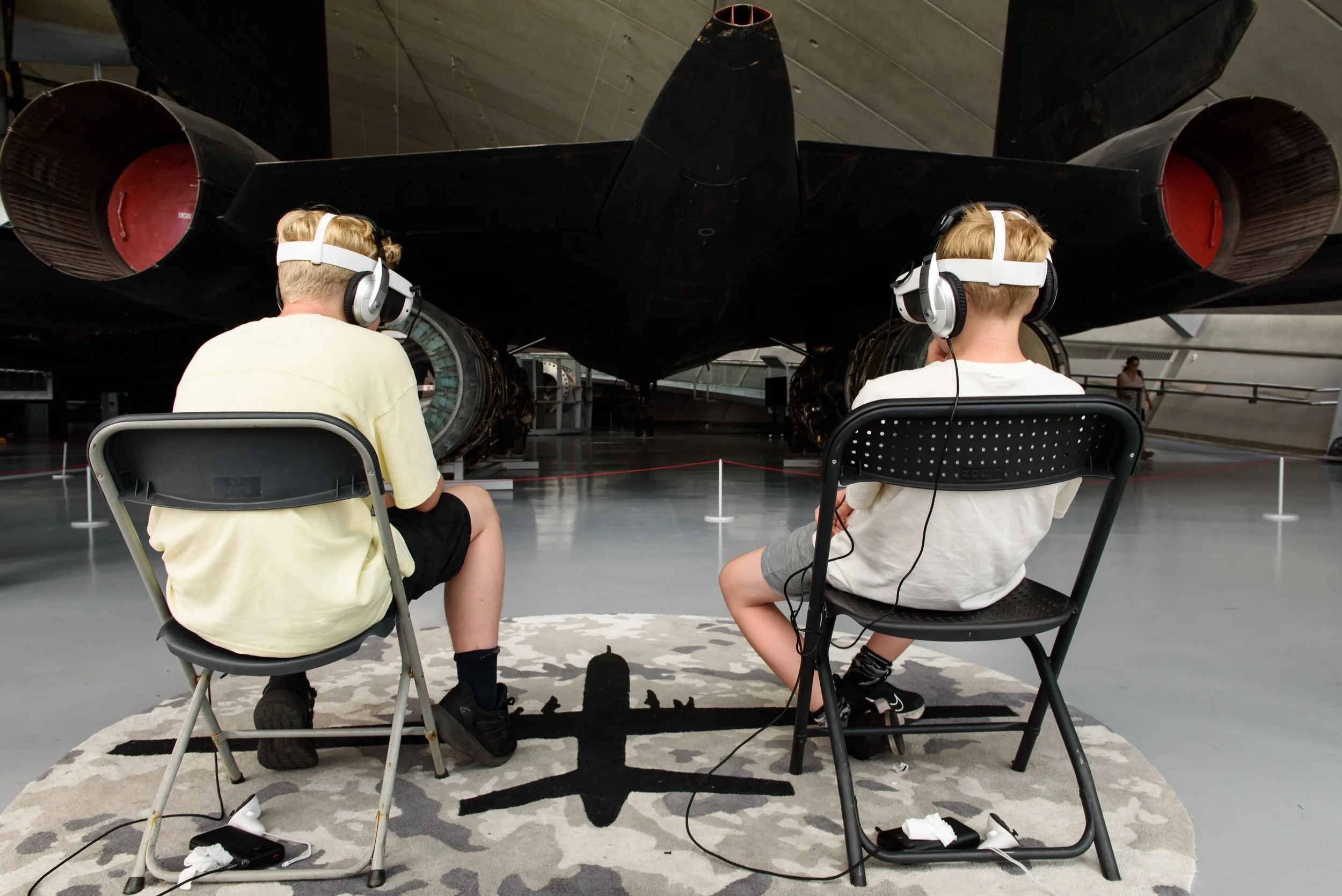
Some thirty metres from our booth stood an exhibit that seemed to anchor the entire experience in uneasy symmetry: an actual Predator drone, its long grey fuselage gleaming faintly beneath the hangar lights. Visitors who emerged from the VR installation often asked whether they might see a “real one,” and so we directed them there—from the printed iteration on our massive mat toward that quiet sentinel resting among the spectres of earlier skies.
It was a discordant sight: this machine, still so recognisable in news footage and public imagination, displayed beside the timeworn artefacts of the Second World War and the Cold War. Was the Predator, I wondered, still the face of modern warfare—or had it already slipped into the curatorial afterlife of the museum, its menace now rendered historical, its sleek body consigned to the same suspended repose as the nearby Lockheed SR-71 Blackbird? For to be placed behind a burgundy velvet rope is to be declared finished, to be embalmed in the grammar of pastness.
And yet, the contradiction was unmistakable. Even as this model sat in tranquil retirement, the real landscape of drone warfare was morphing beyond the hangar’s glass walls. In Ukraine and Russia, the skies are no longer patrolled by these high-altitude sentinels alone, but by swarms of small, propeller-driven craft—multi-rotors, loitering munitions, improvised quadcopters—each cheap, expendable, and devastatingly proximate. The age of the solitary, godlike Predator circling from the stratosphere seems to have given way to one of multiplicity and chaos, of countless eyes and engines buzzing close to the earth.
Still, the Predator endures as a symbol, a point of reference heavy with psychological resonance. For those who have lived under its shadow, its silhouette is not an artefact but a memory—immediate, recurring, and painfully ever-present. I frequently pondered how a visitor from such a place might feel, standing before this polished relic after removing the VR headset: what it might mean to face, in steel and rivet, the very image that had haunted their nights. There is something that lingers within in that duality—the Predator as both relic and revenant, belonging to the museum’s taxonomy of the past while still capable of stirring the pulse of the now.
It is, perhaps, an apt emblem of the 21st century condition: a machine that has become history without ever ceasing to act within it. For what could be more characteristic of our age than this strange coexistence of obsolescence and vitality? We retire our technologies to gilded vitrines even as their shadows hang restlessly across contemporary life; we pronounce them finished, yet their logic endures—in our fears, our ethics, our very architecture of seeing. The Predator, pinned in its hangar like a specimen of history, still hums through the circuits of our imagination, reminding us that modernity rarely buries its dead—it repurposes them.
III: The Place Between Seeing and Saying
It was from that quiet reflection on relics that my gaze would often return to the present—to the living, breathing procession of visitors who filed through the hangar each day. For while the machines stood still, the people never did.
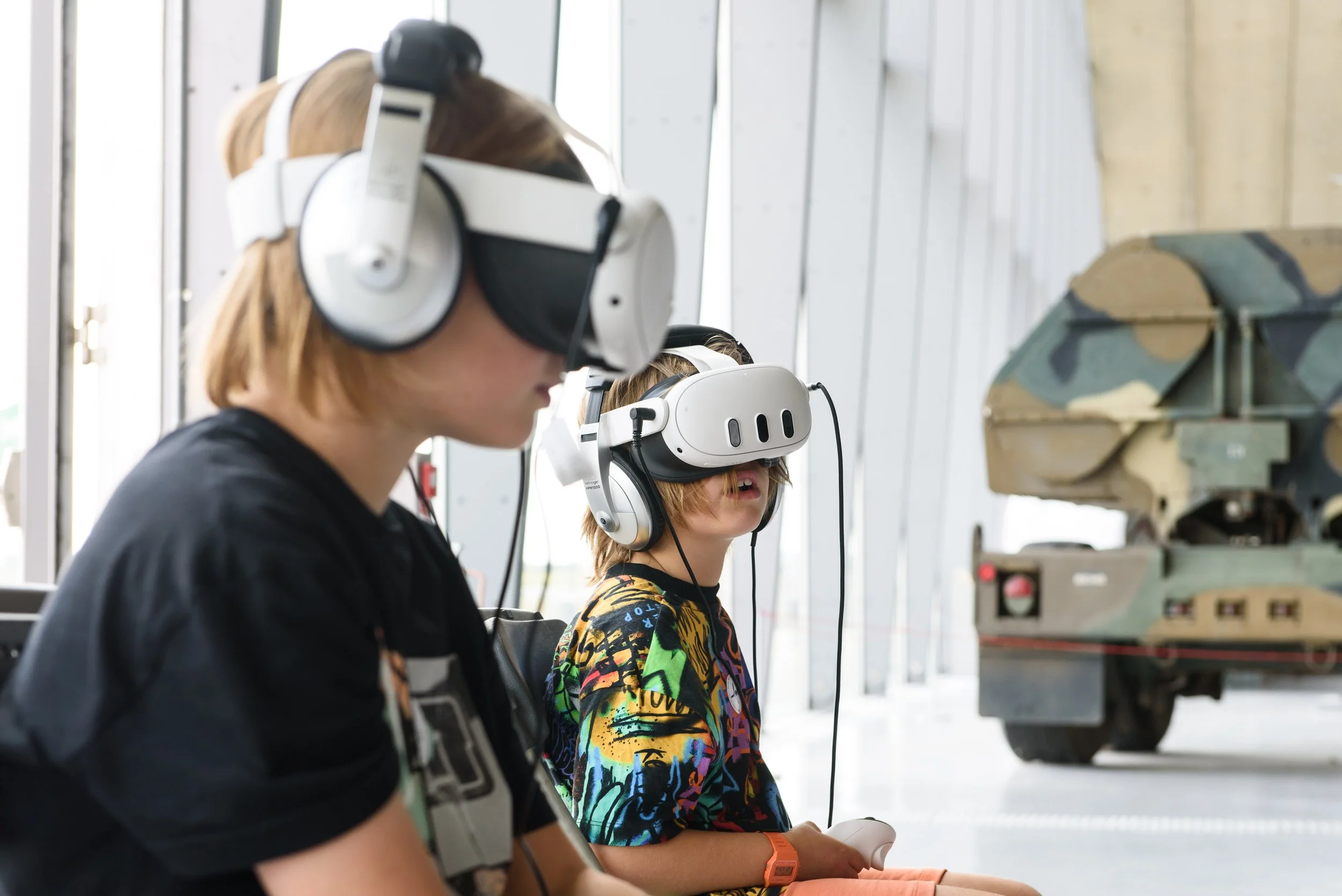
Duxford’s Imperial War Museum, I had been told, tends to attract a rather broad demographic: the curious, the patriotic, the nostalgic, the armchair historians, former military service members, and families with kids. Thus, much of my time there involved abrupt shifts in register: reassuring children that there were no jumpscares lurking in the code; explaining to puzzled adults that the purpose of the piece was not to deliver a lesson neatly wrapped in moral conclusion. More than once I was asked, “What does it mean?” or “What’s the point of this film?”—questions that, while simple on the surface, always carried the faintest tremor of anxiety, as though the absence of a clear message were a kind of failure. My instinct was to resist interpretation, to let the film speak in its own silence. I found myself more preoccupied in what the audience would supply when not given a map.
Yet the questions that stayed with me were the most innocuous, and they came, almost unfailingly, from children. “Is it a scary film?” they would ask. “Does anything bad happen?” And though the pragmatic part of me wished only to reassure—to say no with a smile and usher them toward curiosity—another aspect hesitated. To deny the film’s unease felt like reducing it to a spectacle, a laterally roving panorama of images emptied of consequence, as though it were merely a flight simulator or some VR thrill ride to be completed and forgotten. But to affirm their fear—to say yes—would have been to impose my own reading, to authorise an anxiety that perhaps need not be theirs.
This dilemma became, in its own way, the crux of my contemplations. How does one mediate an experience designed not to instruct but to unsettle? How best to preserve the viewer’s liberty of interpretation while also acknowledging that discomfort—ethical, emotional, or aesthetic—is part of what the film asks us to confront? I began to realise that the work of guiding viewers through Beware Blue Skies was not only logistical or pedagogical, but hermeneutic. It was about finding when to speak and when to let silence do the talking.
“Is it scary?” they asked.
“Only if you know for sure where you’re standing,” was the response I settled for.