
What Makes A Field? Notes from the Critical Drone Studies Conference
By Amy Gaeta, CDAC Postdoctoral Research Associate
From 25-26 June 2026, the Centre for Drones and Cultures (CDAC) hosted the Critical Drones Studies Conference at Jesus College, University of Cambridge. Despite a blistering heat wave across Europe and unpredictable UK trainlines, nearly 40 speakers from various parts of the world came together to discuss drone use, ethics, art, and futures across domains as diverse as land surveying and hobbyist cultures to war and border control. In addition to eleven panels and two plenary conversations, the conference hosted an art exhibition and a pop-up VR experience of our short film Beware Blue Skies.
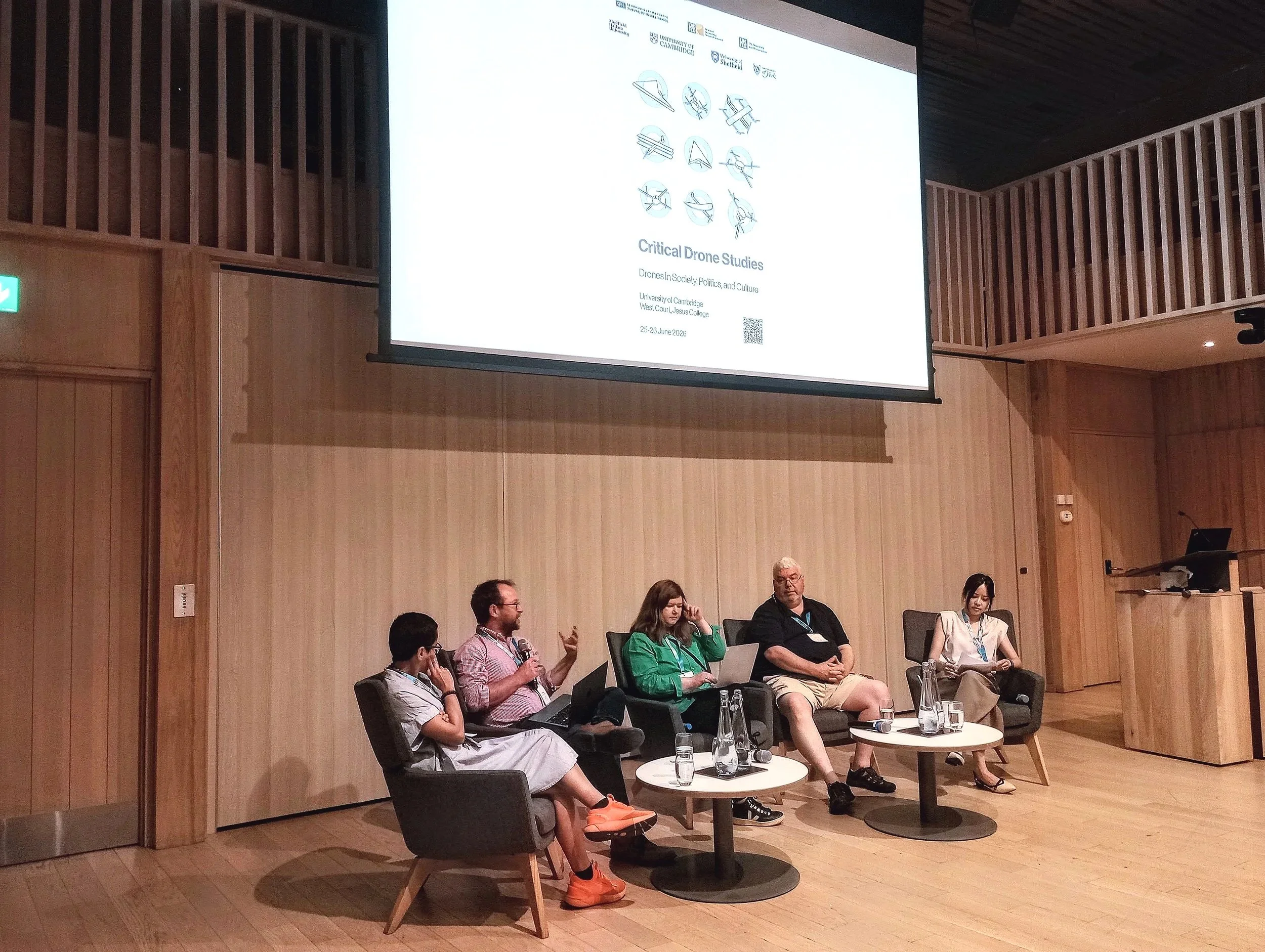
Plenary Session 1 on “Drone Pasts and Futures”, featuring (from left to right) Marjory Da Costa Abreu, Peter Adey, Joanna Tidy, and Chris Cole, with moderation from Beryl Pong
Just a few years ago, it was a bit of a novelty to find an academic article about the critical study of drones that was not centred around conflict, security, or policing. We, the organisers, were excited and grateful to have people share work that allowed us to form panels on the UK drone landscape, political economies, rural space, regulation, humanitarianism, security, and protest, humanism and posthuman war, aerial imaging, affect, birds and swarms, political ecologies, and more-than-human knowledges. It is still a bit uncommon to find such conferences, but the energy and level of engagement at the Critical Drones Studies Conference suggested that perhaps we should be coming together, with both breadth and a critical edge, more often.
For important reasons, questions of martial power, empire, and coloniality were foundational to most of the earlier critical studies of drones, which largely coalesced around the use of drones in the “Global War on Terror,” and much of the language and insights of these earlier works continue to influence how drone warfare and drones in general are understood in critical study. Now, we might look back on these works and group them under the rubric of “critical drone studies.” But, as the conference demonstrated, we are well within a second wave of “critical drone studies,” a field that encompasses a much wider range of contexts, methodologies, geographies, and approaches. This included a more expansive understanding of how to define a drone. As CDAC Co-Investigator Richard Carter said of the conference, “I was encouraged to see the rich array of approaches towards, and outlooks concerning, drones as not simply objects of technology, infrastructure, and policy, but also as vibrant, protean figures within our critical thought and creative imaginaries.”
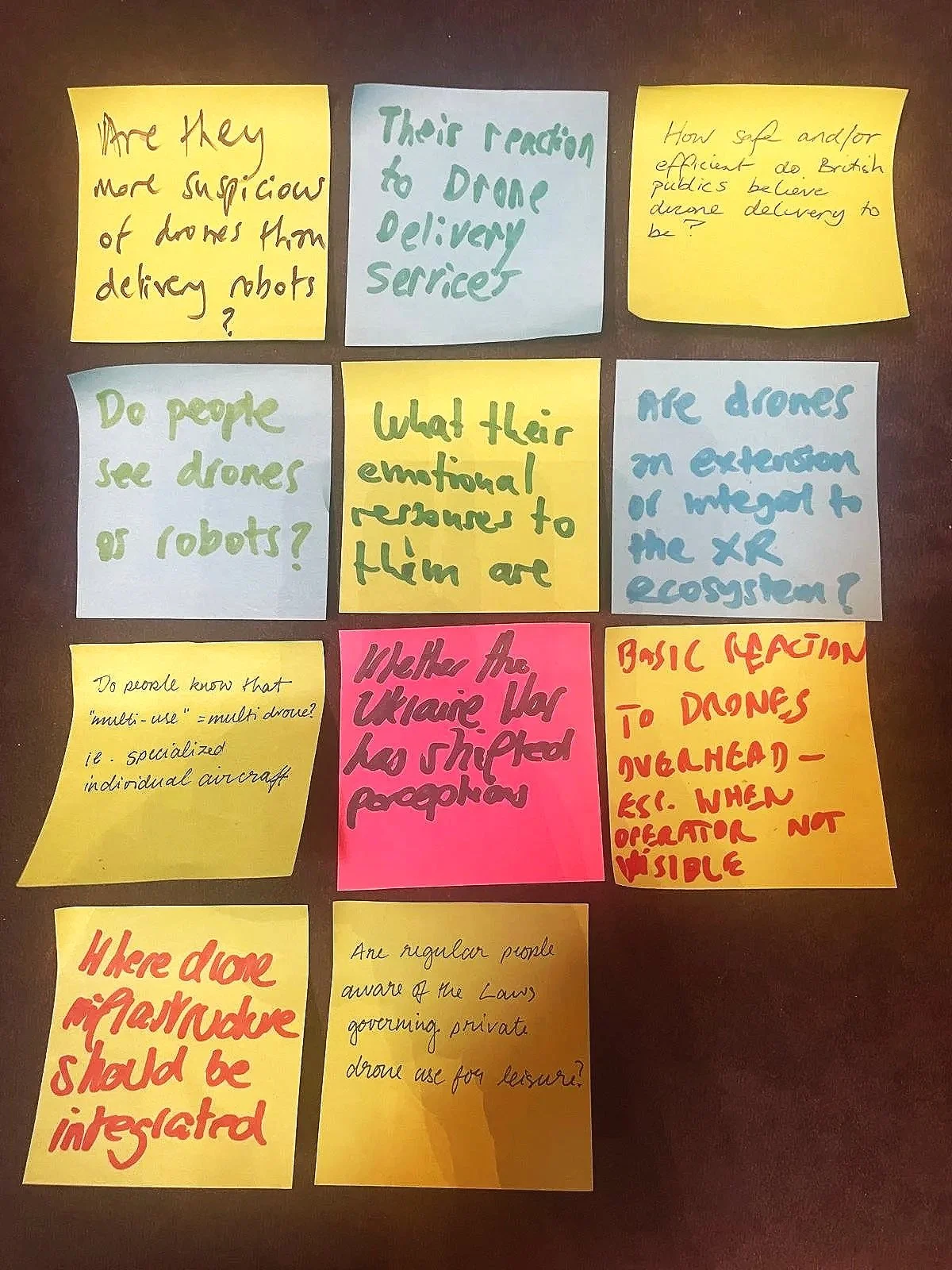
A few post-it responses to our prompt exercise: “What do you want to know about how British publics perceive drone technology”
For those outside of the study of drones, it might come as a surprise that there is such a thing as “drone studies,” let alone “critical drone studies.” As one curious conference attendee said: “I knew people studied drones, but what do you mean [that] it is a field?” It is a good question to ask, and one that stayed with me throughout the conference. If we think of a field as a way to reference a bunch of papers that huddle around a similar object or set of objects, methods, ambitions, or questions, then the field of ‘critical drone studies’ might fall apart as such. Indeed, the conference was exciting because many of us occupied different disciplines and methodological positionings and utilised radically different vocabularies for, approaches to, the ontologies of drones. For some, the drone is most prominently an unmanned aerial robot with a history in martial power, and for others, the drone is chiefly a cultural figure that annexes to core anxieties around human ability, vulnerability, and labour. Carter put it best: “Overall, just as the foundational question of ‘what is a drone’ invites a kaleidoscopic array of potential answers, in line with its sheer multivalency, the conference highlighted how our present methods of researching it are equally so.” These disjunctures are ultimately what help to make the field cohere around a shared set of investments in the drone as an important object of inquiry for broadly understanding technological mediation of human sensing, action, imagining, and storytelling. At a moment when it feels like every discussion of emerging technologies focuses on the risks and potentials of LLMs, woes around Big Tech, and grand-scale narratives, the conference offered us an important reminder of the value of deep, concentrated, and nuanced discussion that refused hype and kept our attention fixed on a shared technology of interest, even if we might contest referring to the drone as a stable referent.
Echoing these questions of the field, CDAC Co-investigator Joanna Tidy encourages us to consider “the fact that many of us are working on drones in some kind of interstitial space; between academic disciplines; between academia and creative practice; between academia and activism or some configuration of all of these. As the field grows and develops, I hope we can all feel that it is a place to be a 'proper' drone scholar each on our own terms; however I think there is also something to be held onto and nurtured that comes from thinking about drones from some form of 'outside' or 'in between.’” Tidy’s comments push us to slightly de-center the drones and consider also the legacies of traditional academic disciplines and boundaries that haunt, and sometimes foreclose, such “interstitial spaces.”
Aligned with Tidy’s comments, the heterogeneity of the conference might also say something about the drone and its implications for the human and more-than-human worlds. What makes it possible for scholars with backgrounds in Computer Science, English, Media Studies, Studio Arts, Geography, and Political Science, among others, to be able to have such rich, critical conversations around a shared object for which we cannot even agree on a definition or shared methodological approach? Marjory Da Costa Abreu, CDAC Co-Investigator, offers one answer to this interdisciplinarity, which is, of course, crucial even as it is practically difficult: “technology does not exist in isolation, and conversations like these help us understand its wider impact on people's lives.” Perhaps another reason drones attract such a wide range of voices lies in how unevenly drone applications are distributed across different people’s lives and the extensive range of those applications, from child’s play to frontline war. Understanding drones requires a decisively non-isolated approach. As Costa Abreu reflects: “The point about me being one of the few academics with a STEM background particularly stood out, as I am a firm believer that basic digital literacy is essential, but it becomes much more meaningful when it is combined with perspectives from the social sciences, humanities and policy.”
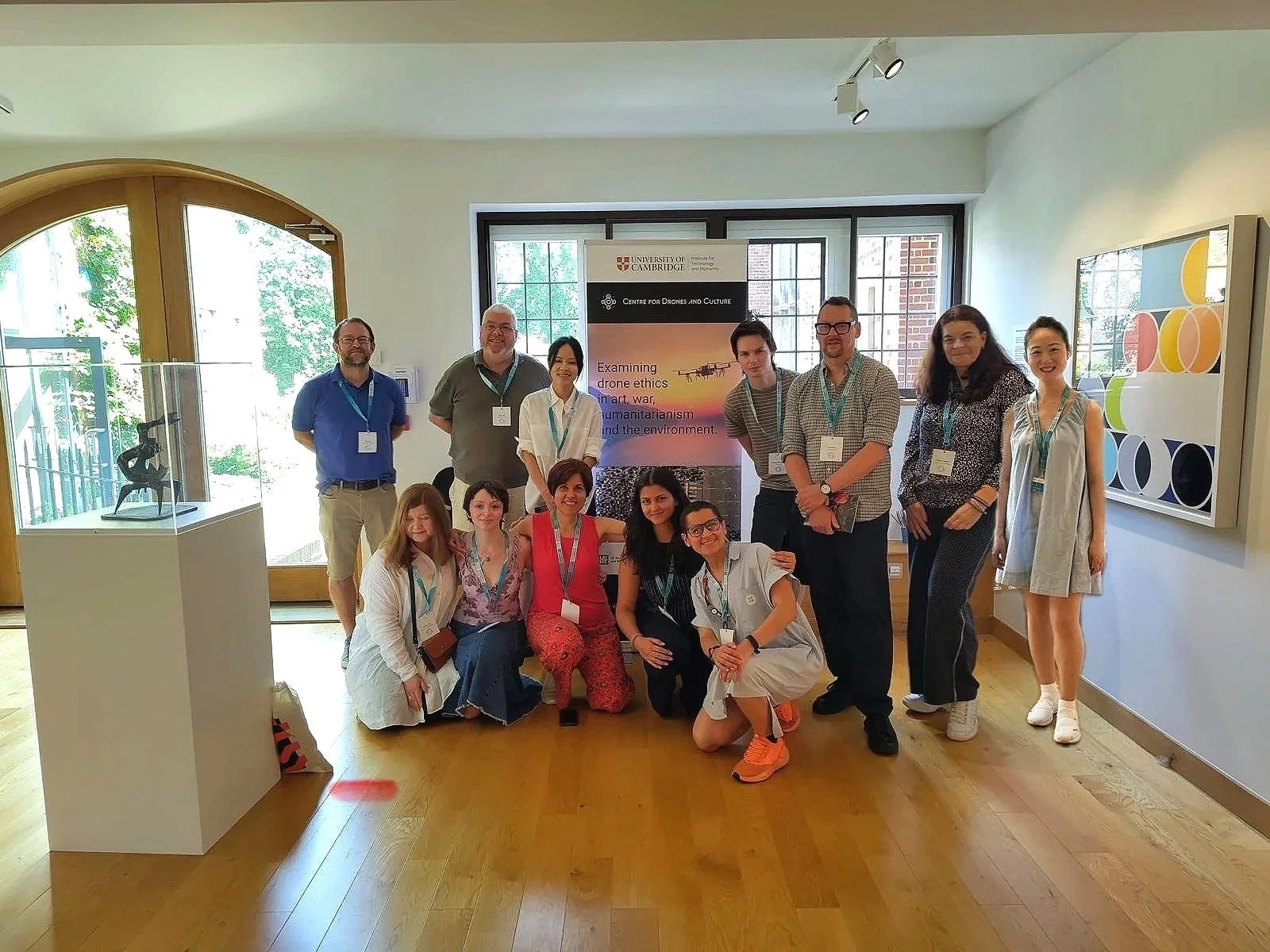
Some members of the CDAC, affiliates, and the conference team. Top row (from left to right): Peter Adey, Chris Cole, Beryl Pong, Joseph McDonnell, Nick Bax, Caroline Fletcher, & Yiyun Mu. Bottom row (from left to right): Joanna Tidy, Amy Gaeta, Yvonne Martin-Portugues, Farah Nanji, & Marjory Da Costa-Abreu
The difficulty mentioned by Da Costa Abreu lies in the other notable element of the conference title— “critical.” Some drone enthusiasts might not be eager for critical drone studies if assuming criticality means a wholesale dismissal of drones. Instead, the criticality practiced at the conference might be best conveyed as a deep curiosity and insistence on imagining other kinds of futures with drones that do not reproduce the current and past regimes of drone-facilitated violence and harms. It also means acknowledging existing drone pasts and drone narratives that may not fit so easily within the regimes scrutinised by earlier drone studies. If, as Carter said, drones operate as “a critical figure in how we have sensed, made sense, and intervened within the world,” then critical drone studies might be appreciated as a project invested in tracing the specific political, cultural, ecological, and economic relations through which drones acquire meaning and force. Across the conference, this meant moving beyond questions of whether drones are simply good or bad and instead examining the conditions under which they become tools of extraction, care, documentation, leisure, militarisation, environmental monitoring, or artistic experimentation. This approach necessitates asking which institutions, infrastructures, histories, and forms of expertise make particular drone futures seem more possible or inevitable while foreclosing others.
Complementing this criticality, or rather ushering it forward, is the range of different geographies, institutions, and forms of state power discussed at the conference, a correction to earlier days in critical drone studies where perspectives on the US drone program tended to take centre stage. This aspect of the conference left Tidy feeling hopeful about “the direction the field is taking and about our ability to collectively reckon, conceptually and normatively, with drones in society, politics and culture and to do so from a global perspective.”
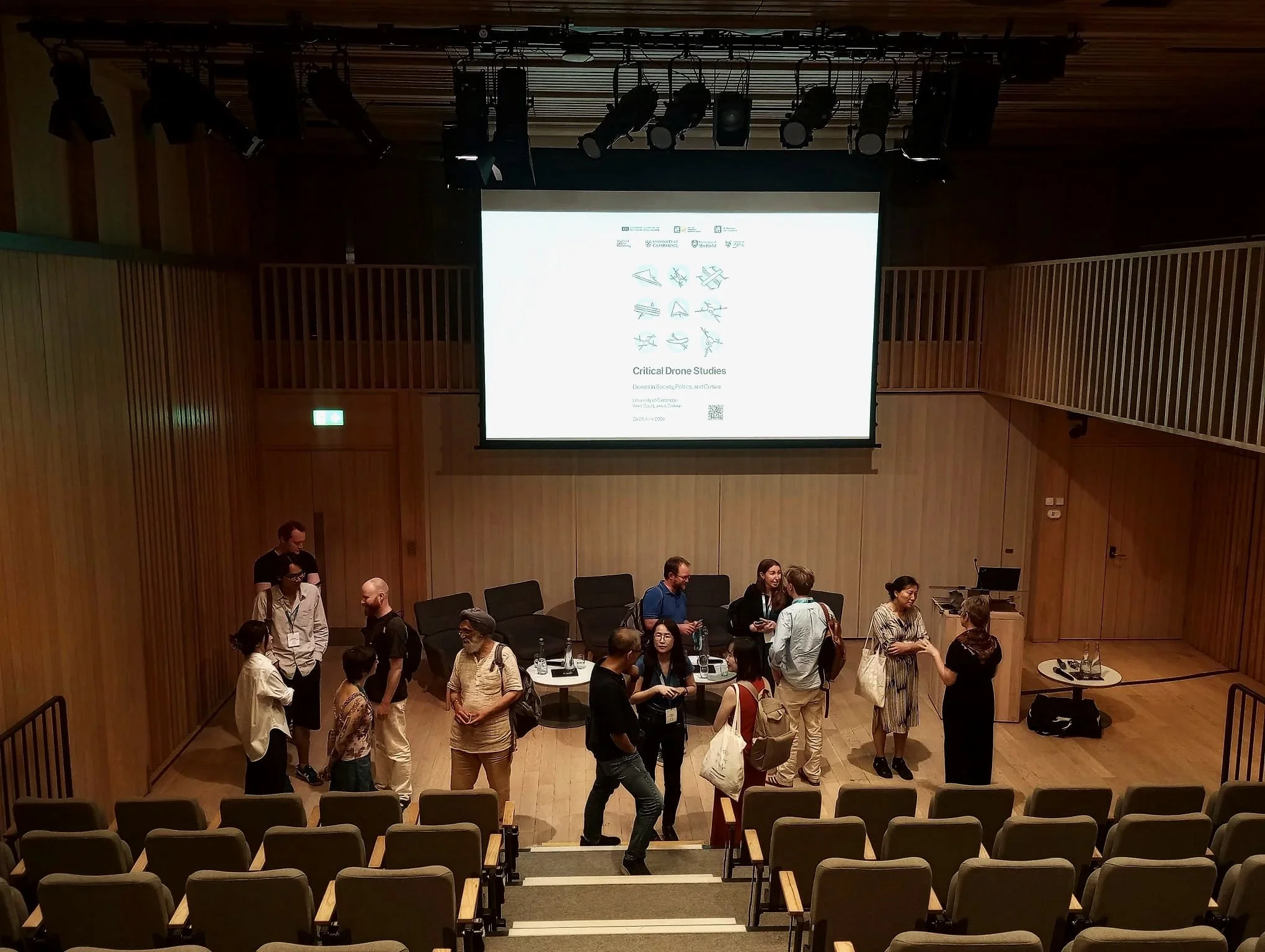
After the final session of the conference, “Drone Affects,” a handful of attendees, speakers, and organisers debriefed and said goodbyes.
How and why critical drone studies constitutes a coherent field may remain open questions, and perhaps that is part of its strength— that we meet in the in-between of disciplines. The conversations over the two days suggested that what binds critical drone studies together is a commitment to taking drones seriously as political, cultural, ecological, and imaginative objects whose effects are felt unevenly across the world. As CDAC Principal Investigator Beryl Pong notes, these uneven effects are all the more important to address as drones become more accessible and mundane. “Today, drones are easier to procure and adapt in military as well as more-than-military spaces than before. The visibility of drones, their creativity, their multi-use affordances, their multimodal components–which make them amenable to being tinkered and experimented with–all require the kinds of critique that interdisciplinary spaces distinctively enable.” If the Critical Drones Studies Conference suggested just one thing, it is that there remains considerable value in creating room where these conversations can unfold across disciplinary and geographic boundaries. At a moment when drones continue to reshape how people move, witness, sense, govern, care, document, and wage war, the need for such conversations seems unlikely to diminish.